Transcription of the video above
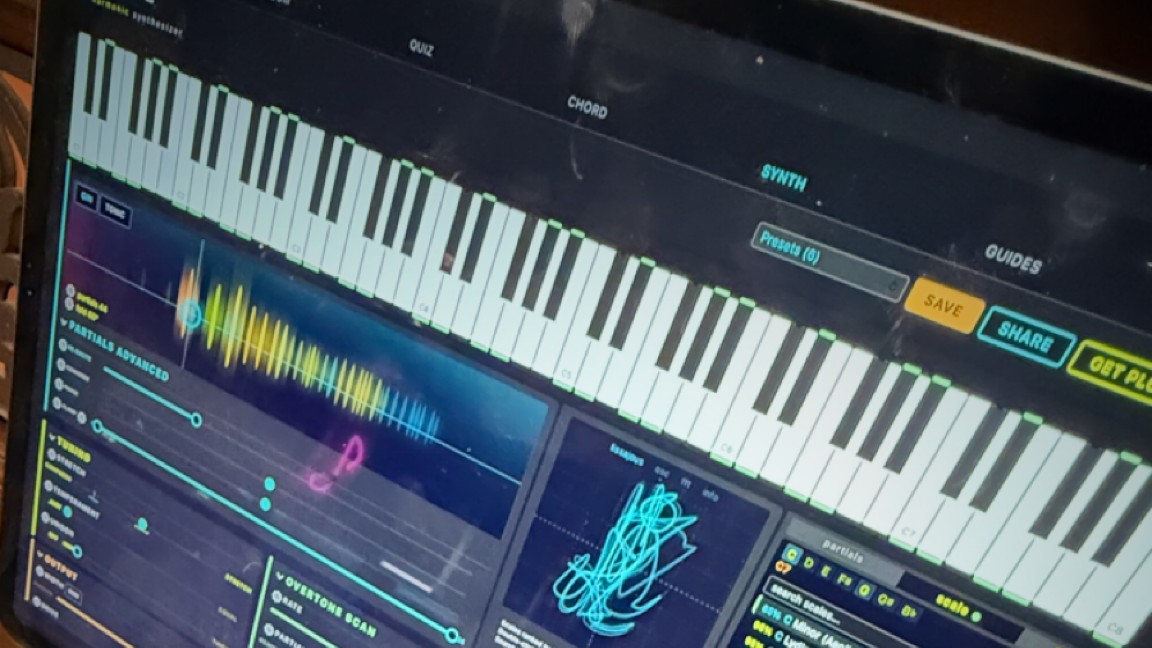
Oops, I made a synthesizer. It began with the simple idea that starts pretty much every one of my classes. And that is, you’re rarely ever playing one note. When you play this one, you’re hearing this one and all of those. If you’ve been here for a minute, old news.
I wanted a visualization, one that showed when you hear this note, you’re also hearing this and that. This and that. And the takeaway is, if this note has this note in it, then this note has this note in it. And if you take that to its logical conclusion, you see this chord has this chord inside it.
And so I thought to myself, what if we could fold it down like this? And if you’re starting to think that sounding like a filter, I did too. And I started to wonder, what would happen if I could move these harmonics down below the fundamental? And then reinforce the tonic, which is where gin and tonic was born.
It’s harmony aware. It can identify partials and track scales from it to not only find suitable scales, but to focus and sculpt those overtones. And what started as a teaching visualization ended up with a synthesizer that is really uniquely harmony-based.
Strictly speaking, this is a form of additive synthesis, but it’s one that I’ve not encountered before, because it allows you to do things like track harmonics. And it lets you do stuff that you couldn’t do with a conventional synth. It’s like adjusting the temperament and the intonation or converging the upper partials.
This is an experiment, and it’s capable of growls and metallic tones. And you can play it without limitation on our website. And there’s a beta version of the plug-in on the website, if you’re brave enough to be an early adopter. We’re just figuring this out as we go along. Try it, share it with someone who belongs in a Beat Kitchen class.