Harmony Torus — The Tonnetz on a Torus You Can Spin and Play
The Tonnetz is a map of notes in which every major and minor chord is a triangle. On a page it repeats forever; in equal temperament it closes up into a torus, and this is that torus. Drag left and right to spin it and up and down to roll it. Tap a triangle to play its chord, and the pad moves one voice at a time to reach it.
How to play it
- Tap a triangle for its chord. Add a second triangle with another finger, or Shift-click with a mouse, for a seventh chord: C and Em side by side make Cmaj7.
- Tap notes on the grid or the keyboard to build any chord one note at a time. The torus names what you have, triad or seventh, and extra notes become colour tones.
- Press MIDI and play: the torus turns to the chord you are holding.
- Chroma moves only by semitone. Diatonic adds the relative moves, a whole tone: C to Am, A♭ to Fm.
Notes shows the Tonnetz itself. Chords shows each chord as a point instead, with every one-semitone move as an edge. Both writes the chord names into the triangles. 3 notes / 4 notes switches between triads and seventh chords.
What is a torus?
A torus↗ is the surface of a doughnut: a circle swept around a larger circle. It wraps around in two directions. Go around the tube and you come back to where you started, and the same happens going around the hole. Pitch wraps the same way in equal temperament: keep stacking an interval and you land back on the note you started from.
How it is laid out
- Around the hole: each row is a circle of fifths, all 12 notes.
- On the diagonals: major thirds up to the right, minor thirds up to the left, as on a printed Tonnetz.
- The triangles: three notes that make a major or minor chord. Two triangles that share an edge share two notes, so one note moves to get from one to the other.
- Colours come from the Harmony Wheel: majors in the tonic yellow, minors in the predominant teal, and the chords that pull like dominants in its reds.
How many chords are there?
Forty triads. There are 12 major, 12 minor and 12 diminished↗ triads, one on each note, and 4 augmented↗ triads, because an augmented triad is three equal major thirds: C+, E+ and A♭+ are the same notes. This counts the notes in a chord, not how they are voiced or spelled.
With 4 notes it is 51 seventh chords: major 7, dominant 7, minor 7, half-diminished 7 and diminished 7. A 6 chord has the same notes as a minor 7 (C6 is Am7), and a minor 6 the same as a half-diminished 7 (Cm6 is Aø7), so those are on it too.
Where it comes from
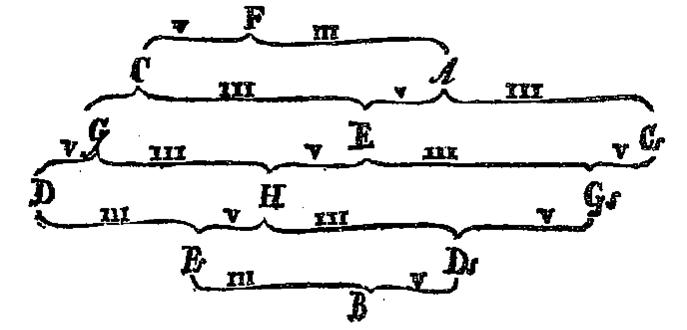
Leonhard Euler↗ drew the first Tonnetz↗ (“tone network”) in 1739. Hugo Riemann↗ and other 19th-century theorists used it to map how chords relate. In equal temperament the grid wraps around in two directions, which makes it a torus. Neo-Riemannian theory↗ took it up again in the 1980s and 1990s. Richard Cohn named the hexatonic cycles in 1996, and Jack Douthett and Peter Steinbach joined them through the augmented triads in 1998, in a graph they called Cube Dance. The Chords view is built on that graph, with the diminished triads added.
The story, step by step
Short reads, in order. Each one adds a piece.
- Triad↗: the four kinds of three-note chord.
- Equal temperament↗: why there are 12 notes and why they wrap around.
- Torus↗: the shape you get when something wraps in two directions.
- Tonnetz↗: Euler’s grid of notes, with chords as its triangles.
- Riemannian theory↗: how 19th-century theorists used it to relate chords.
- Neo-Riemannian theory↗: the 1980s and 1990s return to it, and the moves that change one note.1
- Voice leading↗: moving each note as little as possible.
- Hexatonic scale↗: the six-note scales behind the four rings of triads.
- Augmented triad↗ and diminished triad↗: the two chords that join the rings.2
- Seventh chord↗, diminished seventh chord↗ and octatonic scale↗: the same idea with four notes.3
- Dmitri Tymoczko↗: the composer and theorist who mapped all chords as shapes.4
Read more
- Voice leading: moving each note of a chord as little as possible, which is what every edge here does
- The 10 Chord Toolkit: Part 1: the Musician Basics chapter on building chords
- Tetrachord Toolkit: build scales from two four-note groups and harmonize them
Learn it live
The Musician Basics & Ear Training class is a live cohort on Discord.
-
Richard Cohn, “Introduction to Neo-Riemannian Theory: A Survey and a Historical Perspective,” Journal of Music Theory 42/2 (1998). The hexatonic cycles first appear in Cohn, “Maximally Smooth Cycles, Hexatonic Systems, and the Analysis of Late-Romantic Triadic Progressions,” Music Analysis 15/1 (1996). ↩︎
-
Jack Douthett and Peter Steinbach, “Parsimonious Graphs: A Study in Parsimony, Contextual Transformations, and Modes of Limited Transposition,” Journal of Music Theory 42/2 (1998). This is where Cube Dance comes from. ↩︎
-
Edward Gollin, “Some Aspects of Three-Dimensional Tonnetze,” Journal of Music Theory 42/2 (1998), for seventh chords on a grid of notes. ↩︎
-
Dmitri Tymoczko, A Geometry of Music (Oxford University Press, 2011). ↩︎
Ready to start?
The Residency is your home base — weekly gyms, office hours, feedback sessions, and a community of people doing the same thing you are.
Explore the Residency