
Sound, Vibration, and the Harmonic Series
Everything in this course — every filter, every envelope, every compressor — manipulates the same fundamental phenomenon: vibration. Before we talk about any of those tools, we need to talk about what sound actually is.
And if you take one thing away from this first chapter, let it be this: almost never in nature do you hear only one thing.
What Is Sound?
Pressure wave diagram showing compression and rarefaction in air, with a speaker or tuning fork as the source.
Sound is changes in air pressure. That’s it.
Right now, thousands of pounds of atmospheric pressure are pushing on you from every direction — invisible, unnoticed. Sound is a disturbance in that pressure, propagating outward from a source. No single air molecule travels from the source to your ear. The disturbance travels — a pressure wave, rippling outward through the medium. If that disturbance happens over and over again, rhythmically, we experience it as sound.
The catch: there is only one air pressure at any point in time, at any point in space. Your eardrum measures it like a barometer. So it’s hard to reconcile how you can hear two things at once — and yet you can. A bass guitar, a snare drum, and a vocal all arrive as a single, complex pressure wave hitting one eardrum. Your brain decodes all of it. That’s not just useful for audio engineering — it’s one of the most remarkable phenomena you’ll encounter.
Frequency: The Speed of Vibration
We hear changes in air pressure anywhere between about 20 times a second and 20,000 times a second — though most of us don’t reach either end. Below 20 Hz, it’s still sound, but we don’t experience it as pitch. Above 20,000 Hz, the same — the air itself can only vibrate so fast.
The speed of those cycles is the frequency, measured in hertz (Hz). A sound vibrating 440 times per second is 440 Hz — the note A above middle C. Higher frequency = higher pitch. Lower frequency = lower pitch.
If you’ve ever pushed a kid on a swing, you know the kid always says “faster.” But you can’t push them faster — you can only push them higher. The speed of the swing is fixed by the length of the chain. That’s Newton. A string works the same way: a given length of string vibrates at a fixed frequency. The only way to change the pitch is to change the length, the tension, or the mass. The speed itself is determined by the physics.
The Octave: Exponential Doublings
The octave is the most important ratio in music: double the frequency and you go up one octave. If a string vibrates at 100 Hz, half that string vibrates at 200 Hz — one octave up. A quarter of the string: 400 Hz — two octaves up. Then 800, 1600, and so on.
Notice: 100, 200, 400, 800 — exponential doublings. Octaves are logarithmic, which means instead of saying “let’s play something in the key of 800,” we say “that’s a C — same as 400 was a C, same as 200 was a C.” First C, second C, third C. The octave jumps are the loud, well-reinforced harmonics.
This 2:1 relationship is the foundation of every scale, every chord, every key signature. Every culture on the planet employs the octave. If we ever found life on Mars, they’d probably have octaves too — it’s baked into the way physics works.
Amplitude and Wavelength
Annotated sine wave showing frequency (cycles per second), amplitude (peak height), and wavelength (distance of one cycle).
Frequency tells you how fast the vibration is. Amplitude tells you how big it is — how far the air pressure swings above and below its resting state. Bigger swings = louder sound. We measure amplitude in decibels (dB), a logarithmic scale that matches how your ear actually perceives loudness. (More on that in Chapter 8.)
Wavelength is the physical distance one cycle of a wave occupies. The speed of sound is constant. Frequency and wavelength are not. That means a low-frequency sound occupies more physical space and time than a high-frequency one. A 100 Hz tone has a wavelength of about 11 feet. A 10,000 Hz tone: about half an inch. This is why bass traps are huge, why small speakers struggle with low end, and why microphone placement matters so much at different frequencies.
This has a practical consequence: when you move a microphone, you delay the signal by a distance that corresponds to some wavelength. Combine that delayed signal with the original and certain frequencies will cancel out — that’s phase cancellation, and it comes up everywhere in recording and mixing.
One clarification: just because a low-frequency wavelength occupies several feet of physical space doesn’t mean you need to be that far away to hear it. The sound pressure rises and falls wherever you are.
The Harmonic Series
Harmonic series on a vibrating string — fundamental plus overtones at 2x, 3x, 4x, 5x frequency, with nodes marked. Should also show how the intervals narrow as you go up.
When a string vibrates at 100 Hz, it isn’t only vibrating at 100 Hz. It’s also vibrating at its halfway point — 200 Hz. And at its third — 300 Hz. And at its quarter — 400 Hz.
The set of overtones that ride on top of a fundamental frequency — whole-number multiples (2×, 3×, 4×, etc.) that give every sound its unique character. The raw material you'll be working with throughout this course.
These are the harmonics: overtones riding on top of the fundamental, following a predictable pattern.
You’re hearing all of those things at the same time. The fundamental and its harmonics, layered together in a single complex vibration. Almost every sound in nature works this way — a carrier frequency with stowaways, symbiotic hitchhikers piggybacking on top of it.
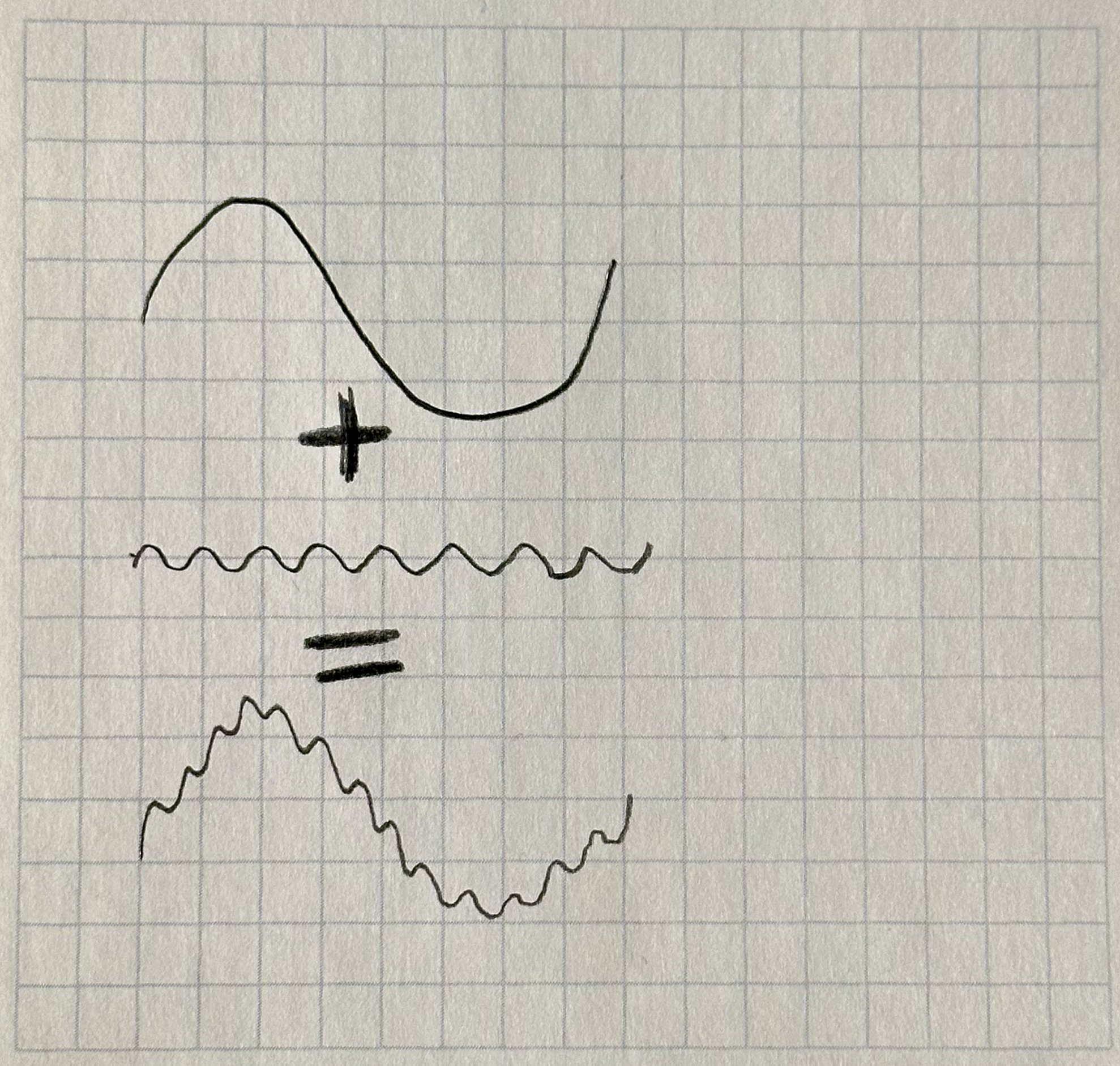
Those harmonics aren’t something you create. They’re already there. When you touch a piano string at its midpoint while the note is ringing, you don’t add the octave — you get rid of the louder, lower fundamental that was masking it. The octave was there the entire time. You just revealed it.
What a thing is is not necessarily what a thing does.
— Nathan Rosenberg, Beat KitchenThe same goes for the other harmonics. The fifth is in there. So is a note two octaves up. As you go higher in the series, the intervals between harmonics get smaller and smaller — because the octave doublings are exponential, but the harmonics are evenly spaced (100, 200, 300, 400…). More and more notes fit between the octave jumps. You can see this reflected in the way an equalizer is laid out — the low end is spaced out, the high end is compressed together. That’s not arbitrary. It’s the harmonic series.
If you’ve ever wondered why a C and a G sound so good together — why that interval sounds “right” — the reason is that the G is already baked into the C. It’s the third harmonic, sitting right there in every C you’ve ever heard. The foundation of harmony isn’t a human invention. It’s physics.
Timbre: Why a Piano Doesn’t Sound Like a Trumpet
Frequency spectrum comparison: same pitch (A 440Hz) played by piano, trumpet, and flute, showing different harmonic profiles.
If a piano and a trumpet both play A at 440 Hz, they’re producing the same fundamental. So why do they sound completely different?
The 'color' or character of a sound — determined by which harmonics are present, their relative levels, and how they change over time. It's what makes a piano sound different from a trumpet playing the same note.
Every instrument produces a unique recipe of harmonics: which overtones are present, how loud each one is relative to the fundamental, and how they change over time. A clarinet emphasizes odd harmonics. A trumpet has a bright, even-harmonic-heavy spectrum. A flute is close to a pure sine wave with very few overtones.
This is why timbre matters for everything in this course: when you’re using EQ, you’re reshaping harmonic content. When you’re using a synthesizer, you’re building harmonic content from scratch. When you’re using a compressor, you’re changing how those harmonics evolve over time. The harmonic series is the raw material you’ll be working with from here on out.
What to Listen For
- Play a sustained piano note and try to hear the overtones above the fundamental. The pitch you identify is the fundamental, but the character — the “piano-ness” — comes from the harmonics. If you can, try damping the string at its midpoint and hear the octave that was hiding inside.
- Put on a song and focus on a single instrument. Try to notice how its timbre changes from the moment a note starts to the moment it dies away. The harmonics shift over time — that’s timbre in motion.
- If you have access to a synthesizer, load a sine wave and listen to how “empty” it sounds — that’s a fundamental with no hitchhikers. Then load a sawtooth wave at the same pitch. All that extra richness is the harmonic series filling in.
Search This Guide
This Course
- 1. Sound, Vibration, and the Harmonic Series
- 2. Filtering Sound — From Harmonics to EQ
- 3. Oscillators and Waveforms
- 4. Shaping Sound — Envelopes, Filters, and Amplifiers
- 5. Modulation and Movement — LFO, Unison, and Glide
- 6. Sound Design and Comparing Synths
- 7. Signal Chain and Gain Staging
- 8. Human Hearing and Loudness Perception
- 9. Introduction to Mastering — Perfect, Pretty, Loud
- 10. Reference Tracks — The Most Important Tool in Mixing
- 11. Signal Flow and Mixer Routing
- 12. Session Setup and Organization
- 13. The Art and Science of Mixing
- 14. Mixing in Practice — The Reference Method
- 15. Introduction to Dynamics — Gates and Expansion
- 16. Compression I — The Basics
- 17. Compression II — Shaping
- 18. Mastering Revisited — Dynamics in Context
- 19. Compression III — Types, Parallel, and Advanced
- 20. Multiband, De-Esser, Dynamic EQ, and Sidechain
- 21. Delay — Time, Rhythm, and the Haas Effect
- 22. Introduction to Stereo
- 23. Mid-Side and Stereo Recording
- 24. Acoustics and Room Treatment
- 25. Reverb — Space, Types, and Practice
- 26. Modulation and Creative Effects
- 27. Sources and Further Reading
Related Videos
When you're ready to take the next step, it starts with a place where you can ask questions. We teach live — small group, cameras optional, taught by someone who gives a shit.
Find Out How You Can Join Us →© 2026 Beat Kitchen School — beatkitchen.io. Licensed under CC BY-NC-SA 4.0. Free to share and adapt for non-commercial purposes with attribution.


