

Who needs synthesis, right? Why don’t we just sample everything? We could — but sampling gives us something static. And musical sounds are expressive because they change dynamically.
Think about a piano note. The moment the hammer strikes the string, there’s a bright burst of energy — lots of harmonics, loud and percussive. Then it quickly settles into a mellower sustain as the higher harmonics die away. Eventually it fades to silence. That whole journey — bright attack, settling decay, quiet sustain, gradual release — is what makes a piano sound like a piano and not like an organ (which holds the same brightness for as long as you press the key).
A shape that describes how a parameter changes over the life of a note — from the moment you press the key to the moment the sound dies away. The tool that takes a static waveform and gives it a life story.
An envelope is how we describe and control that journey. It’s the tool that takes a static waveform and gives it a life story.
An envelope takes a static waveform and gives it a life story.
— Nathan Rosenberg, Beat KitchenADSR: Time Meets Level
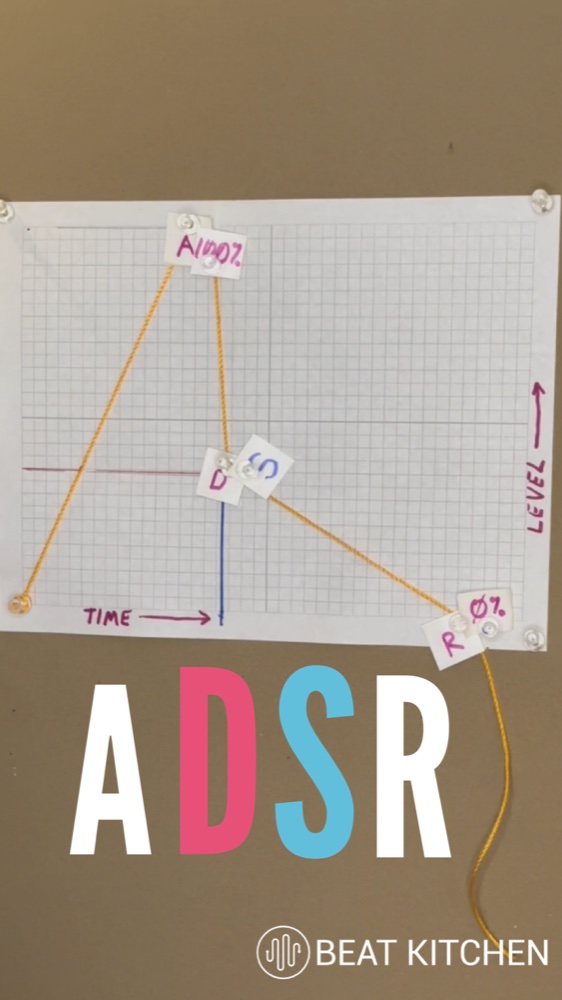
ADSR envelope diagram with all four stages labeled — Attack (time), Decay (time), Sustain (level), Release (time) — clearly showing that sustain is a level, not a duration.
The standard envelope has four stages, and it’s called ADSR:
-
Attack — How long it takes to reach full level after you press the key. A short attack means the sound appears instantly (a drum hit, a pluck). A long attack means it fades in gradually (a pad, a swell). Attack is a duration.
-
Decay — How long it takes to fall from that peak down to the sustain level. A short decay means the sound snaps quickly from its peak to its resting level. A long decay means it drifts down slowly. Decay is also a duration.
-
Sustain — The level the sound holds at while you keep the key pressed. The important distinction: sustain is not a time. It’s a level. It tells you how loud the sound is during the sustained portion, not how long it lasts. How long it lasts is up to you — it holds as long as your finger is on the key.
-
Release — How long the sound takes to fade to silence after you let go of the key. Short release = the sound stops immediately. Long release = it rings out. Release is a duration.
ADSR is all about the intersection of time and level. Attack and release plot durations with assumed destinations (attack goes to 100%, release goes to 0%). Decay plots a duration too, but its destination is the sustain level — and that level is the one parameter you set as a percentage, not a time.
The Amplitude Envelope
Four amplitude envelope shapes compared: pluck (short A/D/R, low S), organ (instant A, full S), pad (slow A, full S, long R), bell (short A, long D, zero S).
The most fundamental envelope on any synthesizer controls amplitude — the volume of the sound over time. This is the VCA (voltage-controlled amplifier) envelope, and it shapes the basic “feel” of the note:
- Short attack + short decay + low sustain + short release = a pluck. Like a guitar pick hitting a string — sharp transient, fast decay, gone quickly.
- Short attack + no decay + full sustain + medium release = an organ. Sound appears instantly, holds steady, fades when you let go.
- Long attack + full sustain + long release = a pad. Sound swells in slowly, holds, fades gradually. Atmospheric.
- Short attack + long decay + zero sustain = a bell or a marimba. Sharp hit, long ring-out, no sustain.
The amplitude envelope is what separates a piano from an organ from a bell from a pad — even if they’re all playing the same waveform at the same pitch. The harmonic content might be identical. The shape of the volume over time is what your ear identifies as the instrument.
The Filter Envelope
Filter envelope in action: diagram showing the filter cutoff frequency rising during attack, settling during decay to sustain level, then closing during release — overlaid on a frequency spectrum.
The amplitude envelope controls volume over time. The filter envelope controls the filter cutoff over time — which means it controls the brightness of the sound as it evolves.
This is where synthesis starts to feel alive. A static filter is fine — you set the cutoff somewhere and the sound stays at that brightness forever. But a filter that moves with each note is what makes a synth sound like a synth.
The classic example: set a low-pass filter to a fairly low cutoff (dark sound). Now apply a filter envelope with a fast attack, moderate decay, medium sustain, and short release. What happens? Each note opens up bright at the start (the envelope pushes the filter cutoff up during the attack), then settles down darker as the decay brings the cutoff back toward the sustain level. That’s the unmistakable “pluck” of subtractive synthesis — the sound starts with a burst of harmonics and quickly retreats.
Flip it: long attack on the filter envelope. Now the sound starts dark and slowly opens up — the classic “wah” sweep, like a filter slowly revealing the harmonics underneath.
The filter envelope has its own ADSR, independent from the amplitude envelope. You control the amount of envelope modulation with a dedicated knob — how far the envelope pushes the filter cutoff above (or below) its resting position.
VCF and VCA: The Subtractive Signal Chain
Complete subtractive synth signal flow: Oscillator → VCF (controlled by filter envelope) → VCA (controlled by amplitude envelope) → Output. Show the envelopes as modulators connected to their targets.
Let’s put this together with the signal flow from last chapter:
Oscillator → VCF (Filter) → VCA (Amplifier) → Output
- The oscillator generates the raw waveform — your harmonic starting material
- The VCF (voltage-controlled filter) shapes that material, controlled by the filter envelope
- The VCA (voltage-controlled amplifier) controls the volume, shaped by the amplitude envelope
Each stage does one job: generate, shape, level. The envelopes are the puppeteers — they control how the filter and amplifier behave over the life of each note. Without envelopes, a synthesizer would produce a static, unchanging tone. With envelopes, it can mimic the dynamic behavior of real instruments or create entirely new sounds that don’t exist in nature.
Exercise: Hear the Difference
Try this on any subtractive synth:
Synthesize a flute: Start with a triangle or sine wave (few harmonics). Set the filter cutoff high (let everything through). Set the amplitude envelope to a medium attack (flutes don’t start instantly), full sustain, medium release. The result should be soft, breathy, and even.
Synthesize a piano: Switch to a sawtooth wave (rich harmonics). Set the filter envelope with a fast attack, quick decay, moderate sustain — so the brightness peaks at the start and settles down. Set the amplitude envelope with a fast attack, long decay, low sustain — so the volume peaks and slowly fades. Now you should hear a brighter, more percussive sound that changes character over its lifetime.
Same synthesizer, same knobs, same architecture. The envelope shapes — how those knobs change over time — are what make one sound like a flute and the other like a piano. This is why envelopes are the difference between a synthesizer and a test tone generator.
What to Practice
- Load any synth with a sawtooth wave. Set the filter to a low-pass with the cutoff in the middle. Now experiment with the filter envelope: change the decay time and the sustain level. Listen to how radically the character shifts — that’s ADSR in action.
- Try making a sound where the amplitude envelope is long and sustained but the filter envelope is short and snappy. Then reverse it: short amplitude, long filter. Hear how the two envelopes interact to create the total character of the sound.
- Play a real instrument (or listen to a recording of one) and try to describe its envelope in ADSR terms. A snare drum? Very fast attack, very fast decay, zero sustain. A violin note? Medium attack, no decay, full sustain, medium release. Building this instinct will help you everywhere.
Search This Guide
This Course
- 1. Sound, Vibration, and the Harmonic Series
- 2. Filtering Sound — From Harmonics to EQ
- 3. Oscillators and Waveforms
- 4. Shaping Sound — Envelopes, Filters, and Amplifiers
- 5. Modulation and Movement — LFO, Unison, and Glide
- 6. Sound Design and Comparing Synths
- 7. Signal Chain and Gain Staging
- 8. Human Hearing and Loudness Perception
- 9. Introduction to Mastering — Perfect, Pretty, Loud
- 10. Reference Tracks — The Most Important Tool in Mixing
- 11. Signal Flow and Mixer Routing
- 12. Session Setup and Organization
- 13. The Art and Science of Mixing
- 14. Mixing in Practice — The Reference Method
- 15. Introduction to Dynamics — Gates and Expansion
- 16. Compression I — The Basics
- 17. Compression II — Shaping
- 18. Mastering Revisited — Dynamics in Context
- 19. Compression III — Types, Parallel, and Advanced
- 20. Multiband, De-Esser, Dynamic EQ, and Sidechain
- 21. Delay — Time, Rhythm, and the Haas Effect
- 22. Introduction to Stereo
- 23. Mid-Side and Stereo Recording
- 24. Acoustics and Room Treatment
- 25. Reverb — Space, Types, and Practice
- 26. Modulation and Creative Effects
- 27. Sources and Further Reading
Related Videos
When you're ready to take the next step, it starts with a place where you can ask questions. We teach live — small group, cameras optional, taught by someone who gives a shit.
Find Out How You Can Join Us →© 2026 Beat Kitchen School — beatkitchen.io. Licensed under CC BY-NC-SA 4.0. Free to share and adapt for non-commercial purposes with attribution.


