

The world isn’t in stereo. You are.
There are only a handful of ways to distinguish one element from another in a mix. You can do it with frequency — carve out space so instruments don’t share the same range. You can do it with time and arrangement — not everybody plays at the same time. Or you can do it with space — placing sounds in different positions so they coexist rather than compete. When two instruments share the same position, they fight. When they occupy different positions, they breathe.
That’s the where of selective leveling — the spatial dimension. Chapter 7 introduced the framework: what is loud (frequency/EQ), when is it loud (dynamics/compression), and now where is it loud (space/stereo). Every spatial decision you make in mixing — panning, width, depth, reverb placement — is selective leveling in the spatial dimension.
Stereo doesn’t exist in nature. That might sound provocative, but it’s true in a specific and important way. What we call “stereo” is a technology — a system for creating the illusion of spatial width using two speakers or two channels of audio. In the real world, sound comes from everywhere in three dimensions. Stereo collapses that into a left-right image between two points. Your brain does the spatial decoding — two ears, timing differences, level differences — and constructs a three-dimensional scene from a two-channel signal. The world isn’t in stereo. You are.
The world isn’t in stereo. You are.
— Nathan Rosenberg, Beat KitchenUnderstanding that stereo is an illusion — and understanding the rules of that illusion — is essential for mixing.
What Is Stereo?
Two channels. Left and right. That’s it. Every piece of stereo audio is just two streams of audio played simultaneously — one through the left speaker, one through the right. When both channels carry the same signal at the same level, you perceive a phantom center — the sound appears to come from directly between the speakers, even though nothing is there.
Pan a signal to the left and the left speaker gets more of it; the right speaker gets less. Your brain interprets the level difference (and the timing difference, if any) as a spatial position. Full left means the sound only comes from the left speaker. Full right means only the right. Center means equal levels from both.
A common misconception: routing a mono track to a stereo bus doesn’t make it stereo. The same signal comes out of both speakers at equal level — that’s the definition of mono. Stereo requires difference between the two channels. If left and right are identical, you have mono on two speakers. The moment the channels diverge — different levels, different timing, different content — you have stereo. This distinction matters because “stereo” isn’t a property of the cable or the bus. It’s a property of the signal. (The Do You Understand Stereo? video demonstrates this with a simple test.)
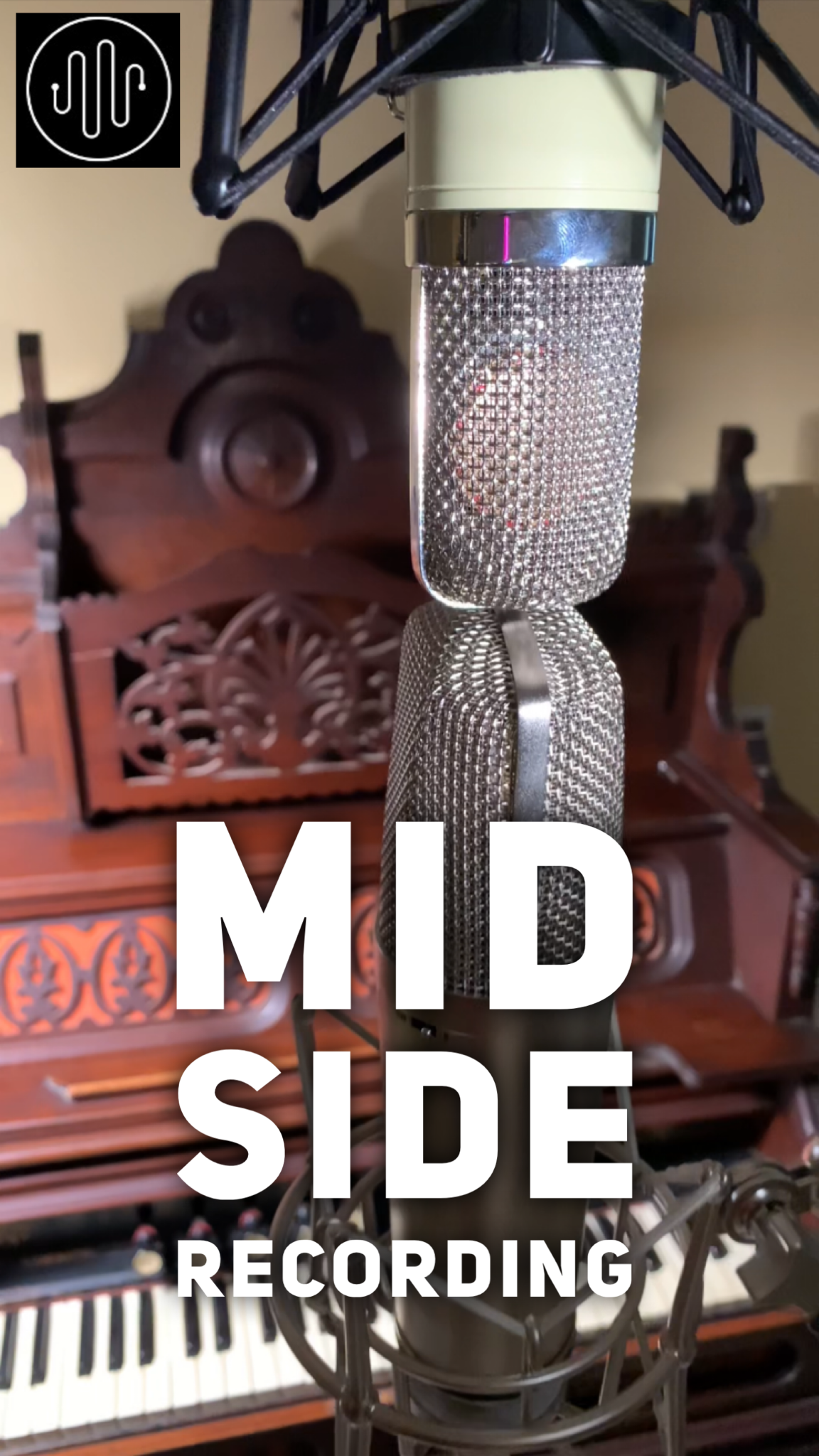
You can think about this difference another way: every stereo signal has a sum (what’s the same in both channels) and a difference (what’s not). The sum is the center. The difference is the width. Chapter 23 takes this idea much further with mid-side processing.
The entire stereo illusion depends on two things: level differences between left and right, and time differences between left and right. Pan knobs control level differences. Delay and Haas effects (Chapter 21) control time differences. That’s the whole toolkit.
Pan Law
A problem: if you take a mono signal and play it equally through both speakers (center), the combined acoustic energy is greater than if you play it through just one speaker (hard left or hard right). Two speakers each playing the signal at the same level means more total energy than one speaker alone.
This means panning a sound from center to hard left (or right) makes it lose volume — even though you didn’t touch the fader. The sound gets quieter as it moves to the side.
A gain adjustment built into the panning system that compensates for the volume increase when a signal plays from two speakers at once. Without it, sounds get louder in the center and quieter at the sides — even though you didn't touch the fader.
Pan law compensates for this. It’s a gain adjustment built into the panning system that reduces the center level slightly so that the perceived loudness stays roughly equal across the stereo field. The standard settings are:
- -3 dB: The most common default. Works for most rooms and monitoring setups.
- -4.5 dB: Used on SSL consoles and appropriate for well-treated control rooms where the phantom center is more prominent.
- -6 dB: Mathematically ideal for perfect acoustic summation, but in practice sounds too quiet in the center for most real-world rooms.
Different DAWs use different pan law settings — check yours. If panning feels like it’s changing the balance when it shouldn’t be, this is often why.
Graph showing pan position vs perceived loudness with three pan law curves (-3 dB, -4.5 dB, -6 dB) overlaid.
Why does this matter? Because if you’re panning aggressively and the balance keeps shifting, pan law might be the reason. A sound that was perfectly balanced when everything was centered can change its perceived level when you spread things out. This isn’t a bug — it’s an inherent property of stereo reproduction.
Mono Compatibility
A significant portion of your audience will hear your mix in mono — or effectively mono. Bluetooth speakers. Phone speakers. Club systems where the subs are summed to mono. TV speakers. Anywhere that uses a single speaker or a narrow stereo field.
When stereo is summed to mono, left and right channels get combined. If two signals were panned hard left and hard right, they now occupy the same space. If those signals have phase relationships (the Haas effect, stereo widening, certain reverbs), the summing can cause cancellations — parts of the signal disappear.
Always check your mix in mono. Every DAW has a mono button or a utility plugin that sums the output. Toggle it and listen. If something disappears or changes dramatically, you have a phase problem that needs to be addressed before you release the track.
The goal isn’t to make the mono version sound as good as the stereo version — it won’t. The goal is to make sure nothing catastrophic happens. The vocal should still be present. The kick and bass should still have impact. No element should vanish entirely.
“When Everything Is Stereo, Nothing Is Stereo”
Width is relative. A wide element only sounds wide in contrast to narrow elements around it. If every track in your mix is a wide stereo source — stereo synths, stereo guitars, stereo reverbs — the mix doesn’t sound wide. It sounds flat and homogeneous. There’s no sense of space because there’s no contrast.
The most impactful stereo mixes use width selectively:
- Anchor the center. Kick, snare, bass, lead vocal — the core of the mix stays centered. This creates a strong, focused foundation.
- Use width for contrast. Guitars, pads, backing vocals, effects — these can spread wider. The width of these elements is perceived in contrast to the narrow center.
- Create movement. An element that starts narrow and widens (or vice versa) draws the ear. An intro that’s centered, opening into a wide chorus, feels like the song is “expanding” — not because of volume, but because of spatial contrast.
The Three Dimensions of Mixing
Stereo gives you three dimensions to work with in a mix — not just left and right:
- Left–Right (panning): Where the sound sits across the stereo field. Controlled by the pan knob.
- Front–Back (depth): How close or far the sound feels. Controlled by level, reverb amount, and brightness — loud, dry, bright sounds feel close; quiet, wet, dark sounds feel far.
- Up–Down (frequency): Where the sound sits in the frequency spectrum. Low instruments feel grounded, high instruments feel airy. This isn’t a physical dimension, but your brain interprets it spatially.
Every mixing decision you make operates in at least one of these dimensions. The best mixes use all three deliberately — they have width and depth and frequency space, creating a three-dimensional illusion from a two-channel medium.
3D stage diagram showing left-right (panning), front-back (depth via level/reverb), up-down (frequency), with example instrument placements.
A note on headphone mixing: headphones bypass the room entirely (Chapter 24 covers why that matters) and present a more intimate stereo image — sounds feel like they’re inside your head rather than in front of you. Pan positions and stereo effects will sound wider on headphones than on speakers. If you mix primarily on headphones, check on speakers regularly. The Mixing in Headphones article covers the tradeoffs in detail.
Top-down stage diagram showing instrument placement: lead vocal center-front, drums center-mid, guitars stage left/right, pads wide-back.
What to Practice
- Pan a static mix. Take a session where everything is centered. Without changing levels, pan each element to create a stereo picture: drums centered, bass centered, vocals centered, guitars and keys to the sides, effects wider still. Listen to how the mix opens up spatially.
- Check in mono. After panning, hit the mono button. Does anything disappear? Does the balance change dramatically? If so, you have phase issues to address. Most often, fixing the width of one problematic element resolves it.
- Sketch a stage diagram. Before mixing, sketch where each element goes left-to-right and front-to-back. Use panning for left-right and volume/reverb for front-back. Compare the result to your original static mix.
- A/B width contrast. Take a verse where the instruments are narrow and a chorus where they widen. Listen to how the width change creates a sense of the song “opening up” — even if the volume doesn’t increase much. That’s the power of spatial contrast.
Search This Guide
This Course
- 1. Sound, Vibration, and the Harmonic Series
- 2. Filtering Sound — From Harmonics to EQ
- 3. Oscillators and Waveforms
- 4. Shaping Sound — Envelopes, Filters, and Amplifiers
- 5. Modulation and Movement — LFO, Unison, and Glide
- 6. Sound Design and Comparing Synths
- 7. Signal Chain and Gain Staging
- 8. Human Hearing and Loudness Perception
- 9. Introduction to Mastering — Perfect, Pretty, Loud
- 10. Reference Tracks — The Most Important Tool in Mixing
- 11. Signal Flow and Mixer Routing
- 12. Session Setup and Organization
- 13. The Art and Science of Mixing
- 14. Mixing in Practice — The Reference Method
- 15. Introduction to Dynamics — Gates and Expansion
- 16. Compression I — The Basics
- 17. Compression II — Shaping
- 18. Mastering Revisited — Dynamics in Context
- 19. Compression III — Types, Parallel, and Advanced
- 20. Multiband, De-Esser, Dynamic EQ, and Sidechain
- 21. Delay — Time, Rhythm, and the Haas Effect
- 22. Introduction to Stereo
- 23. Mid-Side and Stereo Recording
- 24. Acoustics and Room Treatment
- 25. Reverb — Space, Types, and Practice
- 26. Modulation and Creative Effects
- 27. Sources and Further Reading
Related Videos
When you're ready to take the next step, it starts with a place where you can ask questions. We teach live — small group, cameras optional, taught by someone who gives a shit.
Find Out How You Can Join Us →© 2026 Beat Kitchen School — beatkitchen.io. Licensed under CC BY-NC-SA 4.0. Free to share and adapt for non-commercial purposes with attribution.


