Fold, Gin, and Tonic
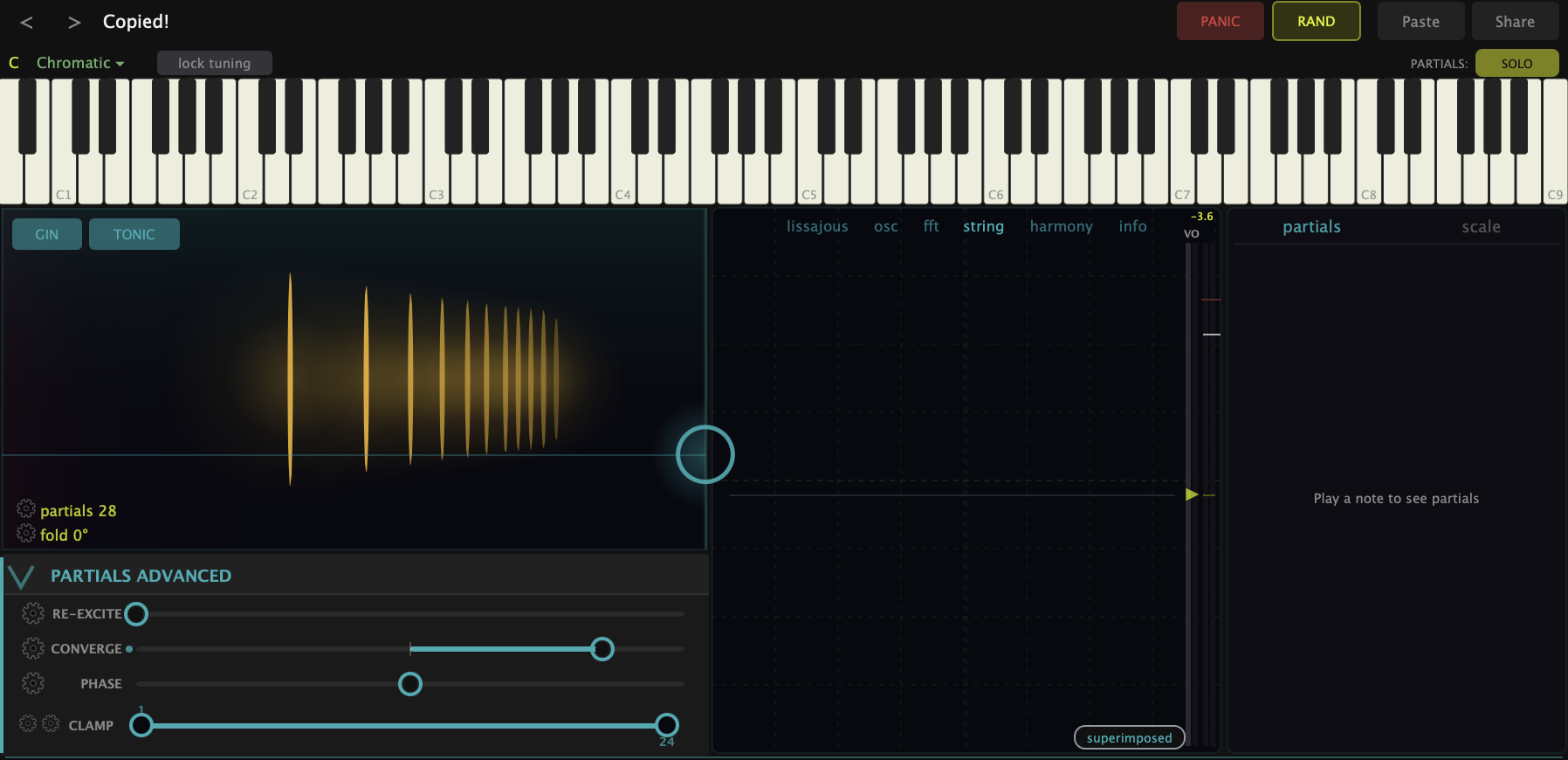
Three controls sit right on the partials matrix — the horizontal Fold axis and the GIN and TONIC buttons above it — and together they’re what makes BKS Harmonic unlike anything else. They all deal with the same region: the content at and below the fundamental. They’re closely related, but they are not the same thing, and it’s worth getting the order straight: Fold makes it, Gin admits it, Tonic tidies it.
Where the idea came from
Play a C, then drop an octave. You’ve got your fundamental, and a little way up the stack you’ve got a G — the fifth, sitting there in the harmonic series whether you asked for it or not. The series above any single note is exactly what gives rise to the scale: the octaves, fifths, and thirds all show up as overtones.
So the question behind this synth was: what if you could take that structure living up in the partials and fold it back down — into and below the octave you’re actually playing? That’s what Fold does.
Fold
Fold is the horizontal axis of the matrix (the fold 0° readout tracks it). As you push it right, the synth folds the harmonic series down through its octave layers. Lower-octave layers crossfade in — including partials below the fundamental — the upper harmonics get a boost, and past the midpoint the fundamental itself starts to duck. It’s a continuous spectral morph, not a switch: a little fold thickens the bottom, a lot of fold completely rearranges where the energy of the sound lives.
If that reminds you of a filter sweep, good — it covers similar ground (moving energy between high and low). But a filter does it by removing frequencies. Fold does it by relocating harmonics into other octaves. Nothing is thrown away; it’s moved. That’s why a fold sweep has a body and motion a filter sweep doesn’t.
Gin
Here’s the catch with folding below the fundamental: sometimes you want those sub-octave partials, and sometimes you don’t. GIN is the on/off gate for them.
- Gin on — the below-the-fundamental layers Fold creates are admitted. You get that deep, folded-down weight.
- Gin off — those sub-octave partials are skipped, so the spectrum stays at or above the note you played, even at high Fold.
So Fold creates the sub content; Gin decides whether you hear it.
Tonic
When you do let the sub-octaves in, they can get muddy — there’s a lot going on below the root. TONIC cleans that up. It ducks the non-root intervals down there, keeping only the partials related to the tonic of the key. Gin lets the sub-octaves in; Tonic keeps them harmonically tidy, anchored to the root instead of smearing.
Using them together
Think of it as a chain. Fold is your main expressive control — the dial that pulls the whole harmonic structure down through the octaves, with all the motion and weight that brings. Gin is the gate that decides whether the sub-fundamental layers are part of the sound. Tonic is the cleanup that keeps that low content rooted.
A common starting move: turn Gin on, push Fold in until the bottom blooms the way you want, then add Tonic until the low end feels anchored rather than muddy. And because Fold is a continuous parameter, it’s a natural modulation target — put it under an envelope or an LFO (see the modulation chapter) and each note folds down as it plays, a sweep that’s related to a filter the way a key change is related to a fade.
What to Practice
- Turn Gin on and slowly push Fold to the right while holding a note. Listen for the lower octaves folding in and the fundamental starting to duck past the midpoint.
- Now toggle Gin off and on at a high Fold setting. That’s the difference between admitting the sub-octave layers and keeping the sound at or above the played note.
- With Gin on and plenty of Fold, bring up Tonic. Hear the low end tighten as the non-root partials duck out.
- Play a chord and try the same thing. Fold moves the whole harmonic structure of the chord at once — a completely different result from a filter on the same chord.
Search This Guide
This Course
- 1. What the Harmonic Synth Is
- 2. The Partials Matrix
- 3. Fold, Gin, and Tonic
- 4. Seeing Sound — the Scope
- 5. Partials Advanced
- 6. Sculpt — Shaping the Spectrum
- 7. The Overtone Scan
- 8. The Harmonic Envelope
- 9. The Harmonic Gate
- 10. Tuning — Stretch, Temperament, and Unison
- 11. Source 2 — the Second Layer
- 12. The Filter
- 13. The Envelope
- 14. Modulation — Making It Move
- 15. Output
- 16. Effects
- 17. Presets, Settings, and the Top Bar
- 18. Audio In and Resynthesis
When you're ready to take the next step, it starts with a place where you can ask questions. We teach live — small group, cameras optional, taught by someone who gives a shit.
Find Out How You Can Join Us →© 2026 Beat Kitchen School — beatkitchen.io. All rights reserved. Unauthorized reproduction or distribution of this material is prohibited.