
Partials Advanced
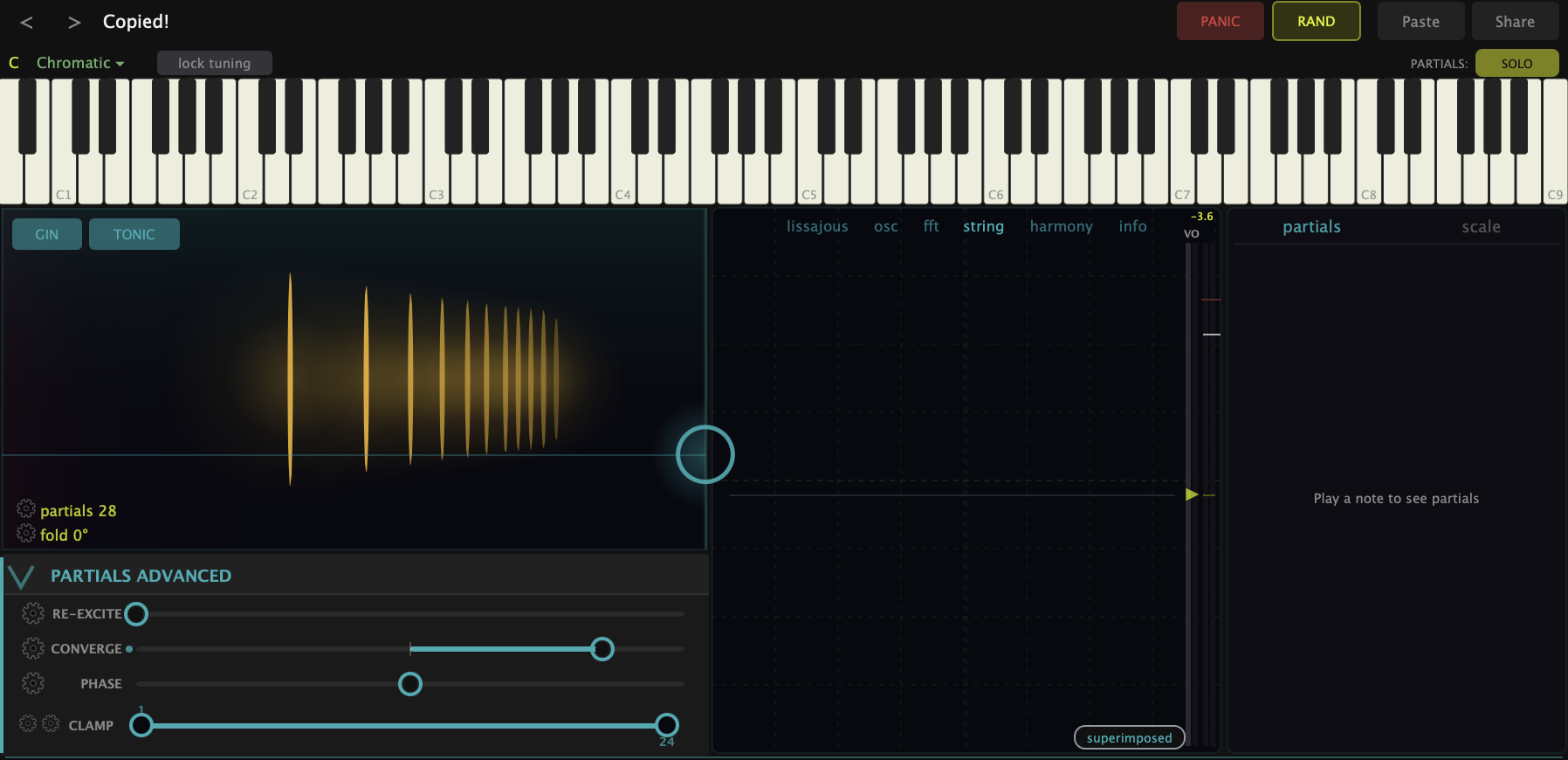
The partials matrix sets the broad shape of your spectrum. The Partials Advanced strip, tucked just below it, is where you reach in and rearrange the partials themselves. Four sliders, each doing something you can’t get from the matrix alone.
Converge
Converge moves all the partials together along the pitch axis. Pull it down (−) and they compress toward a single pitch — the harmonics crowd in on each other and the sound thickens into a dense cluster. Push it up (+) and they spread apart, pulling away from the natural series into wide, bell-like, slightly clangorous territory. It’s one of the quickest ways to take a normal-sounding patch somewhere metallic or otherworldly.
Phase
Phase is a bipolar phase spread, and it’s subtler — it doesn’t change which partials are present, only how their waveforms line up. At the center it’s off. Push it positive and you get a linear (Schroeder) phase ramp; the slider behaves a bit like a pitch bend as you move it. Pull it negative and you get a triangle peak at the middle partial, which reads more like a spectral tilt. Phase changes are easiest to see on the oscilloscope and easiest to hear on sustained, bright sounds — the timbre shifts without the pitch or the harmonic content changing.
Clamp
Clamp sets a hard band on which partials are allowed to sound — a harmonic floor and ceiling, anywhere from partial 1 to 24. Clamp the bottom up and you thin out the low harmonics; pull the top down and you cap the brightness no matter what else is going on. It’s a blunt, dependable way to keep a patch in a register — especially useful when the Overtone Scan or modulation would otherwise push partials past where you want them.
Re-excite
Re-excite revives octave layers below the current Fold position — bringing back lower-layer harmonics that a high Fold setting would otherwise have crossfaded away. In practice, reach for it when you’ve folded a sound down hard (see Fold, Gin, and Tonic) and want some of that lower-octave body back without dialing Fold itself back.
What to Practice
- Hold a bright sustained note and sweep Converge slowly from − to +. Listen for the cluster tightening, then spreading into a bell.
- Park Converge at center and move Phase while watching the oscilloscope. The shape changes; the pitch doesn’t.
- Set a Clamp band around the low partials and play across the keyboard — the sound stays in its register no matter how hard you push the matrix.
Search This Guide
This Course
- 1. What the Harmonic Synth Is
- 2. The Partials Matrix
- 3. Fold, Gin, and Tonic
- 4. Seeing Sound — the Scope
- 5. Partials Advanced
- 6. Sculpt — Shaping the Spectrum
- 7. The Overtone Scan
- 8. The Harmonic Envelope
- 9. The Harmonic Gate
- 10. Tuning — Stretch, Temperament, and Unison
- 11. Source 2 — the Second Layer
- 12. The Filter
- 13. The Envelope
- 14. Modulation — Making It Move
- 15. Output
- 16. Effects
- 17. Presets, Settings, and the Top Bar
- 18. Audio In and Resynthesis
When you're ready to take the next step, it starts with a place where you can ask questions. We teach live — small group, cameras optional, taught by someone who gives a shit.
Find Out How You Can Join Us →© 2026 Beat Kitchen School — beatkitchen.io. All rights reserved. Unauthorized reproduction or distribution of this material is prohibited.