
Tuning — Stretch, Temperament, and Unison
Most synths are locked to equal temperament and never mention it. BKS Harmonic puts tuning on the front panel, because once you’re building sounds out of the harmonic series, tuning is part of the sound design.
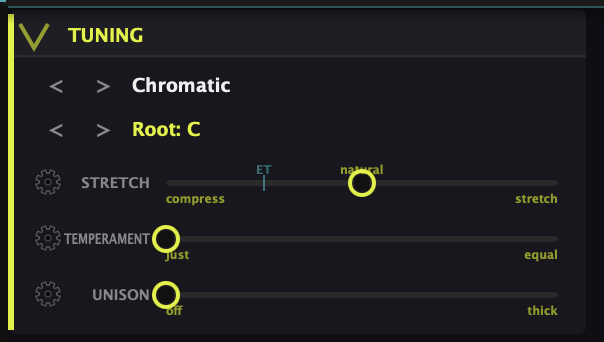
Temperament — just versus equal
Temperament crossfades between two ways of tuning the notes you play:
- Just (left) — intervals built from pure whole-number ratios. A fifth is a perfect 3:2; chords lock together and stop beating. The catch is the one every tuning system runs into: pure intervals only work in one key at a time. Just intonation retunes relative to the lowest note you’re holding — unless you turn on lock tuning (top bar), which pins it to the scale root so the whole key stays consistent.
- Equal (right) — the standard compromise: twelve equal steps, every key equally usable and equally, slightly out. This is what lets you play in all keys without retuning.
Play a sustained fifth and sweep Temperament from equal to just — you’ll hear the beating slow and stop as the interval snaps pure. That’s the sound of just intonation, and it’s hard to unhear.
Stretch — inharmonicity
Stretch detunes the upper partials away from the pure series. At the center (natural) the partials are a pure harmonic series. Push it toward stretch (+) and the highs go progressively sharp — the natural inharmonicity of a real piano string, which is why a stretched setting instantly reads as “acoustic.” Pull toward compress (−) and the upper partials pull in. A little stretch warms up an otherwise clinical additive tone; a lot turns it bell- or metal-like. (The ET marker on the slider shows where equal-tempered spacing sits.)
Unison
Unison detunes slightly sharp and flat copies of each partial and layers them. Off, the sound is clean and single; push toward thick and it widens into a chorused, ensemble character — the classic “more than one of me” richness, applied per-partial rather than per-voice.
Scale and Root
Above the sliders, Chromatic / Root set the scale and key. Leave it Chromatic for no scale clamp, or pick a scale to snap the keyboard and feed the synth’s scale-aware features (the Overtone Scan’s scale mode, the Harmonic Gate). Root sets the key those features center on.
What to Practice
- Hold a fifth and sweep Temperament from equal to just. Listen for the beating disappear.
- Set a clean additive patch, then add a touch of Stretch toward the sharp side. Notice how much more “real” it sounds.
- Turn Unison up under a pad for instant width, then back off until it’s just a shimmer.
Search This Guide
This Course
- 1. What the Harmonic Synth Is
- 2. The Partials Matrix
- 3. Fold, Gin, and Tonic
- 4. Seeing Sound — the Scope
- 5. Partials Advanced
- 6. Sculpt — Shaping the Spectrum
- 7. The Overtone Scan
- 8. The Harmonic Envelope
- 9. The Harmonic Gate
- 10. Tuning — Stretch, Temperament, and Unison
- 11. Source 2 — the Second Layer
- 12. The Filter
- 13. The Envelope
- 14. Modulation — Making It Move
- 15. Output
- 16. Effects
- 17. Presets, Settings, and the Top Bar
- 18. Audio In and Resynthesis
When you're ready to take the next step, it starts with a place where you can ask questions. We teach live — small group, cameras optional, taught by someone who gives a shit.
Find Out How You Can Join Us →© 2026 Beat Kitchen School — beatkitchen.io. All rights reserved. Unauthorized reproduction or distribution of this material is prohibited.