
The Harmonic Envelope
A normal envelope shapes the volume of the whole note. The Harmonic Envelope shapes the volume of part of the spectrum — a group of partials you choose — on its own timeline. That’s how you get sounds where the top end blooms in late, or a single harmonic clicks at the attack and then disappears, while the rest of the note behaves normally.
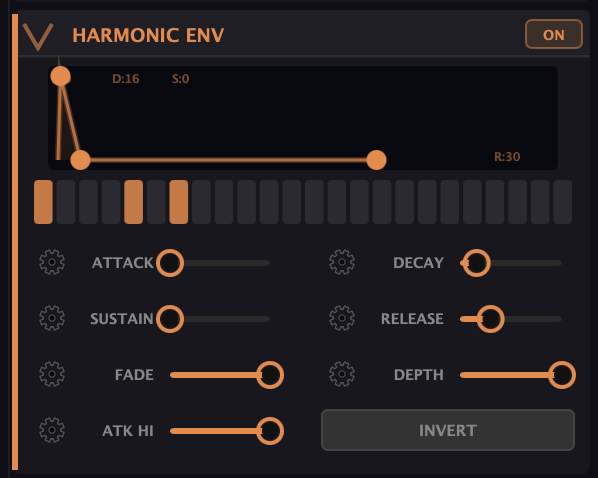
Pick the group
The grid of cells is where you choose which partials belong to the envelope’s group — light up the ones you want it to control. Everything outside the group is left to the main envelope. Put just the fundamental in the group and you can make the body of the note swell independently; put only the top few partials in and you control just the “air.”
Shape it
Once a group is selected, it gets its own ADSR — attack, decay, sustain, release — that swells those partials in, drops them, holds them, and fades them. Three more controls tune the feel:
- Fade — held-note decay for the group. At 0 the group sustains; turn it up and the grouped partials keep fading even while you hold the key.
- Depth — how strongly the envelope shapes the group’s level. Low Depth is a gentle tilt; high Depth is a dramatic swell. This is an excellent velocity target — map velocity to Depth and harder notes bloom harder.
- Atk Hi — the level the attack peaks at. Below 100, the attack tops out short of full, for a softer entry.
- Invert — flips the whole thing, so the group fades out instead of in. Great for sounds that start bright and settle, like a plucked attack that loses its top.
What it’s for
The classic moves: a slow attack on just the upper partials, so a pad opens up over a second or two while the fundamental is already sounding. A fast, inverted envelope on the top harmonics for a percussive “tick” on the attack that vanishes. A swell on the fundamental alone under a steady set of overtones. Because it’s independent of the main envelope, you’re animating the timbre over time, not just the loudness.
What to Practice
- Put only the top few partials in the group, give it a slow Attack, and play a sustained chord. Hear the brightness arrive after the note starts.
- Select just the fundamental, turn Invert on with a short decay, and listen to the body drop away while the overtones hang.
- Map velocity to Depth (see the modulation chapter) so the harmonic swell responds to how hard you play.
Search This Guide
This Course
- 1. What the Harmonic Synth Is
- 2. The Partials Matrix
- 3. Fold, Gin, and Tonic
- 4. Seeing Sound — the Scope
- 5. Partials Advanced
- 6. Sculpt — Shaping the Spectrum
- 7. The Overtone Scan
- 8. The Harmonic Envelope
- 9. The Harmonic Gate
- 10. Tuning — Stretch, Temperament, and Unison
- 11. Source 2 — the Second Layer
- 12. The Filter
- 13. The Envelope
- 14. Modulation — Making It Move
- 15. Output
- 16. Effects
- 17. Presets, Settings, and the Top Bar
- 18. Audio In and Resynthesis
When you're ready to take the next step, it starts with a place where you can ask questions. We teach live — small group, cameras optional, taught by someone who gives a shit.
Find Out How You Can Join Us →© 2026 Beat Kitchen School — beatkitchen.io. All rights reserved. Unauthorized reproduction or distribution of this material is prohibited.