The Envelope
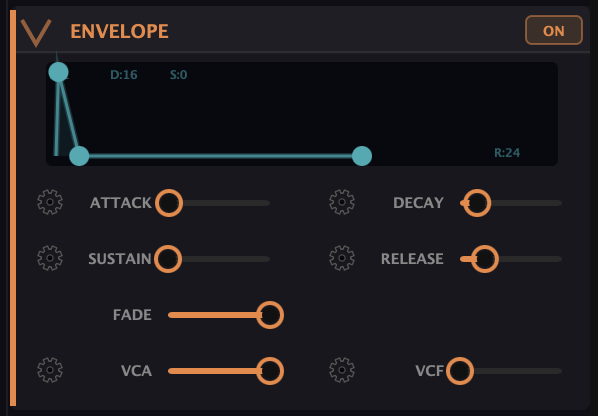
The main Envelope shapes how each note rises and falls. The four ADSR stages are standard; the three extra controls are where it gets expressive and a little different from the usual.
ADSR
- Attack — how long the note takes to reach full level. Fast for percussive and plucked sounds, slow for pads that swell in.
- Decay — how long it takes to fall from the attack peak down to the sustain level.
- Sustain — the level the note holds at while you keep the key down.
- Release — how long the sound takes to fade after you let go.
Fade
Fade is the control that turns a synth that holds forever into one that decays like a real instrument. At 0, a held note sustains indefinitely — organ and pad behavior. Turn it up and a held note keeps fading toward silence even while you’re holding the key, the way a piano or mallet note dies away. It’s the single knob that separates “sustained” instruments from “struck” ones.
VCA and VCF — the amounts
These two decide how much the envelope actually does:
- VCA — how much the envelope shapes the volume while the note is held. At 0 the level is flat (organ-style — on while held, off when released); at 100 the full envelope shapes the loudness. Either way, the release always fades to zero when you let go.
- VCF — how much the envelope opens the filter. Turn it up and every note gets a filter sweep that follows the envelope shape — bright on the attack, settling as it decays. This is how you get the classic envelope-into-filter “wow” without touching the mod matrix.
A second envelope
There’s also a second envelope, Env 2, living over in the Modulation section, with its own ADSR and its own VCA/VCF contribution amounts — for when you want one envelope on the amp and another driving something else entirely. That’s covered in the modulation chapter.
What to Practice
- Build a pad: slow Attack, full Sustain, Fade at 0 so it holds.
- Now make it a mallet: fast Attack, Fade up so a held note decays on its own.
- Turn VCF up on a bright patch and play — hear the filter sweep on every note, shaped by the envelope.
Search This Guide
This Course
- 1. What the Harmonic Synth Is
- 2. The Partials Matrix
- 3. Fold, Gin, and Tonic
- 4. Seeing Sound — the Scope
- 5. Partials Advanced
- 6. Sculpt — Shaping the Spectrum
- 7. The Overtone Scan
- 8. The Harmonic Envelope
- 9. The Harmonic Gate
- 10. Tuning — Stretch, Temperament, and Unison
- 11. Source 2 — the Second Layer
- 12. The Filter
- 13. The Envelope
- 14. Modulation — Making It Move
- 15. Output
- 16. Effects
- 17. Presets, Settings, and the Top Bar
- 18. Audio In and Resynthesis
When you're ready to take the next step, it starts with a place where you can ask questions. We teach live — small group, cameras optional, taught by someone who gives a shit.
Find Out How You Can Join Us →© 2026 Beat Kitchen School — beatkitchen.io. All rights reserved. Unauthorized reproduction or distribution of this material is prohibited.